


On Saturday afternoon, Trump announced to the world that the United States was locked, loaded, and ready to go against Iran with levels of military terror not seen since World War II; it sounded very much like a final warning issued while jet engines were literally warming up on the tarmac.
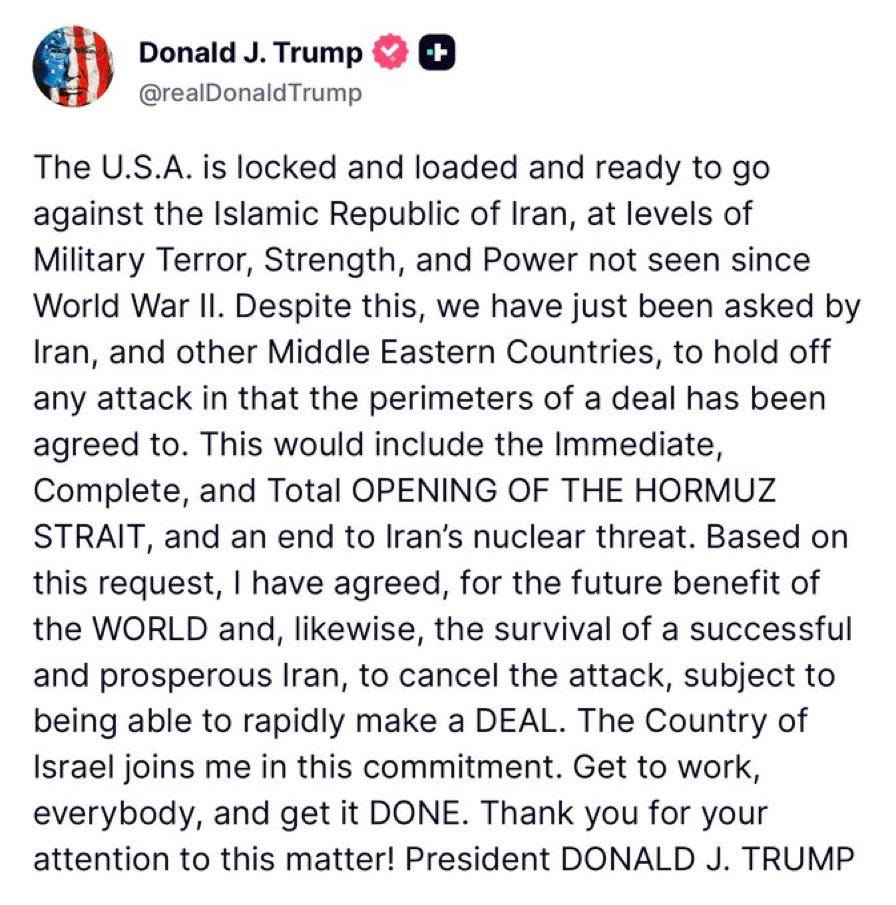
By Saturday evening, however, he had completely cancelled the attack, posting that Iran and several Middle Eastern countries had asked him to wait because they had supposedly agreed on the outline of a massive deal: the Strait of Hormuz would reopen, Iran’s nuclear threat would vanish, and Israel would be wrapped into the whole neat little package. Predictably, the internet immediately split into its usual binary camps: half the room decided the initial threat was pure theater from a guy who ultimately prefers dealmaking over bombing, while the other half accused him of losing his nerve the second a general showed him a map.
Both of those hot takes completely miss the actual brick that got thrown through the window. Tehran never publicly offered those concessions, and within hours, Fars (the Iranian wire service linked directly to the regime) was openly dunking on his account, calling his claims about Hormuz fantasy land while insisting management of the strait remained under their exclusive control. The crucial intervention actually came from Saudi Arabia’s Mohammed bin Salman, who released an unusually candid summary of his call with Trump emphasizing the necessity of dialogue; translated into plain English, the Saudis were gently reminding Washington that striking Iranian oil fields meant Iranian missiles landing on Saudi oil fields, and because those two power grids sit right next door to each other, Riyadh was standing directly inside the splash zone. Qatar, the UAE, Turkey, and Pakistan were all screaming into the phone for the exact same reason: their proximity to the battlefield gave them leverage, and a Gulf monarch publicly demonstrated that he could halt an American strike package with a single phone call.
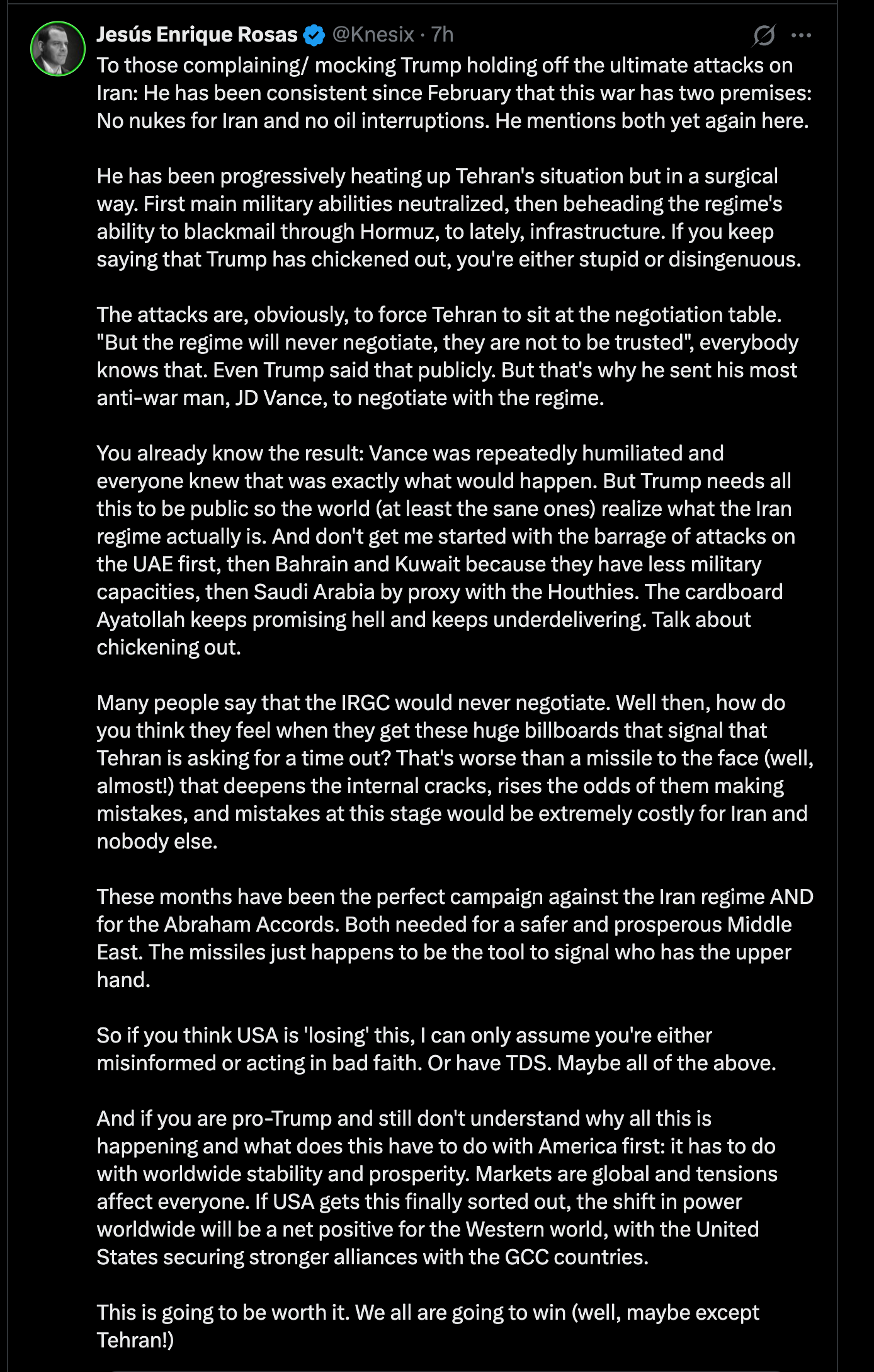
From the outside, this strategy looks completely erratic; you degrade capability, squeeze the strait, hit infrastructure, pause, get called a coward, and repeat… but when you step back, it looks less like random mood swings and far more like a controlled escalation routine designed to shape Iran’s information environment one painful step at a time. Look at the regime’s sheer panic: the fact that a state-linked news outlet felt compelled to contradict the American president before their own government could even formulate a formal statement proves just how desperate someone inside that system was to convince the domestic public that Tehran hadn’t just gotten bullied. Sure, Trump makes this ten times harder on himself by negotiating in broad daylight on social media before the ink is dry, but the real truth won’t be found in tweets or press releases; it will be found at the Strait of Hormuz over the next two weeks, specifically in the massive, awkward gap between what Washington claims was agreed upon and what actually happens on the water. Meanwhile, countries like the UAE spent the weekend doing absolute zero military heavy lifting, quietly positioning themselves to collect all the political dividend checks the second the dust finally settles.
A note for institutional readers.
If you’re reading this professionally, at a sovereign fund, a family office, an investment desk, a policy shop, or a defense or intelligence team, what you’re getting here is the public-tier version of work that can be produced privately, sharper and tailored to a specific mandate.
Private engagements are taken on a selective basis. If your team would benefit from custom synthesis on the geopolitics-energy-AI stack, leave your details here: https://forms.gle/1asdUqUfp5fZzus8A
No follow-up unless you request one in the form itself.


