

Premium Briefing | The Power Pundit
Executive summary
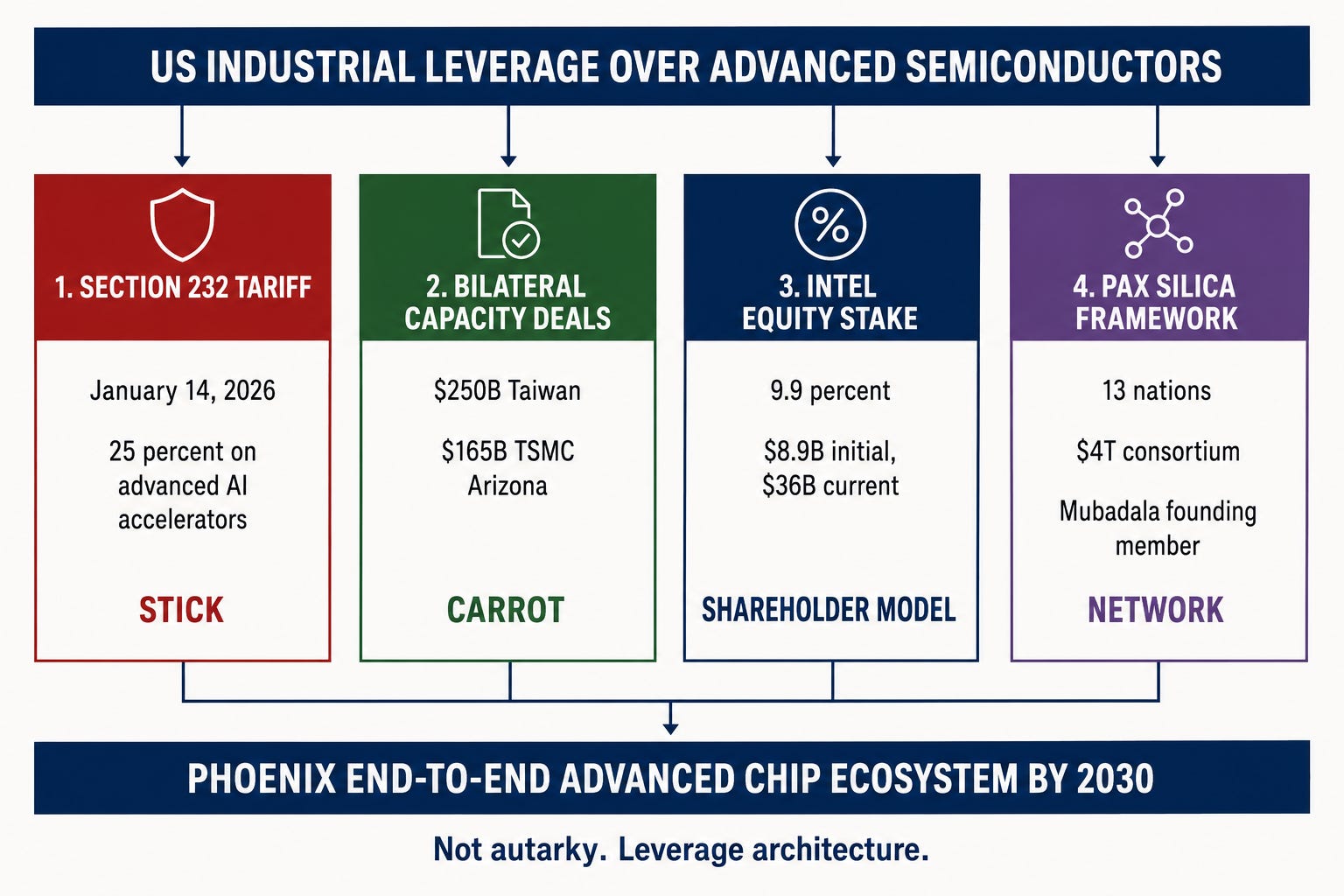
Trump’s Fox News line this week, telling everyone in the Taiwanese chip industry to come to America, is the political ceiling of the relocation story. The actual policy floor sits about three feet lower and has been under construction for eighteen months. The administration has built a four-piece industrial leverage architecture made up of Section 232 tariffs, bilateral capacity deals, equity-for-subsidies on Intel, and the thirteen-nation Pax Silica framework, and the whole thing is already operational and producing physical results. TSMC’s Arizona project is in volume production on 4-nanometer nodes for Nvidia and Apple, the second module enters 3-nanometer production in the second half of 2027, Amkor’s Peoria packaging campus comes online in early 2028, and by the end of this decade the Phoenix area becomes the first place outside East Asia where an advanced AI chip can be designed, fabricated, and packaged without leaving North America.
This is real, but it is also not what most people think it is. The administration is not building a fortress; it is building a network with the US at the top of a tiered hierarchy of allied producers. The rhetoric is autarky, but the actual policy is leverage, and the investment thesis underneath the rhetoric concentrates not in the chip names everyone knows but in the bottlenecks that gate the buildout: high-voltage transformers, advanced packaging capacity, specialty gases, cleanroom construction, and the announced sovereign-wealth investment consortium that may absorb Gulf capital into the next phase.
1. The leverage architecture
The legal stack now in place is more aggressive than most observers realize, and it is doing real work.
On January 14, 2026, the administration issued Presidential Proclamation 11002, imposing a 25 percent ad valorem tariff under Section 232 of the Trade Expansion Act on a narrow category of advanced semiconductor imports. The scope is narrow by design, targeting advanced AI accelerator chips meeting defined performance thresholds, hitting the Nvidia H200 and AMD MI325X by name, while exempting US data centers, startups, R&D applications, and chips imported to support the domestic supply chain buildout. This is a chisel aimed precisely at the high-margin slice of the import market, where the leverage is highest and the political cost is lowest.
The tariff is paired with a bilateral mechanism. Taiwanese firms building new fabs on US soil can export specified quantities of chips without paying Section 232 duties, and South Korea was negotiating similar terms by mid-January. The combined tariff-plus-exemption structure is the same negotiating mechanism Trump used in the first administration with Mexico and Canada, scaled up to the largest industrial dependency in the global economy, and it is working. The renegotiated US-Taiwan trade deal commits Taiwanese firms to more than $250 billion in US investment commitments, with TSMC’s own commitment now at $165 billion, expanded from the initial $65 billion announced under the Biden administration. The Arizona project has grown to six fabs, two advanced packaging facilities, and a domestic R&D center.
The equity model is the third piece. In August 2025, the administration converted Intel’s CHIPS Act grants and Secure Enclave funds into a 9.9 percent ownership stake, acquiring 433.3 million primary shares at $20.47 per share for a total investment of $8.9 billion. After Intel’s Q1 2026 earnings beat, that stake has appreciated substantially, on the order of $36 billion at recent stock prices. The administration has become an official shareholder, and it structured a completely different deal with TSMC because TSMC had leverage Intel did not. Different leverage produces different deal structures, and the two together are a working model for how to convert subsidy dollars into strategic alignment.
The fourth piece is Pax Silica, and it is the piece that almost nobody outside policy circles has fully internalized.
2. Pax Silica: why the network beats the fortress
The administration established Pax Silica at a US-led summit in Washington on December 12, 2025, as a positive-sum, multinational coalition designed to secure the AI supply chain across trusted partner nations. Founding signatories were the US, Japan, South Korea, Australia, Singapore, Israel, the UK, Greece, Qatar, and the UAE, with India joining in February 2026 and the Philippines becoming the thirteenth member in April. Under Secretary of State Jacob Helberg is the public face of the framework, which integrates critical mineral extraction, semiconductor fabrication, logistical networks, and compute infrastructure under a single diplomatic and economic umbrella.